Wiring The Citadel: Observatory Automation and Run-Scoped File Naming
The Problem: Silent Overwrite and a Passive Observatory
The Citadel launched with an Observatory directory containing five empty data folders — quality-reports/, cost/, latency/, evaluations/, metrics/ — and a README that said "keep this folder passive." The intent was right, but nothing actually filled it. No run wrote anything there. After two pipeline runs, neither had left a trace in the Observatory.
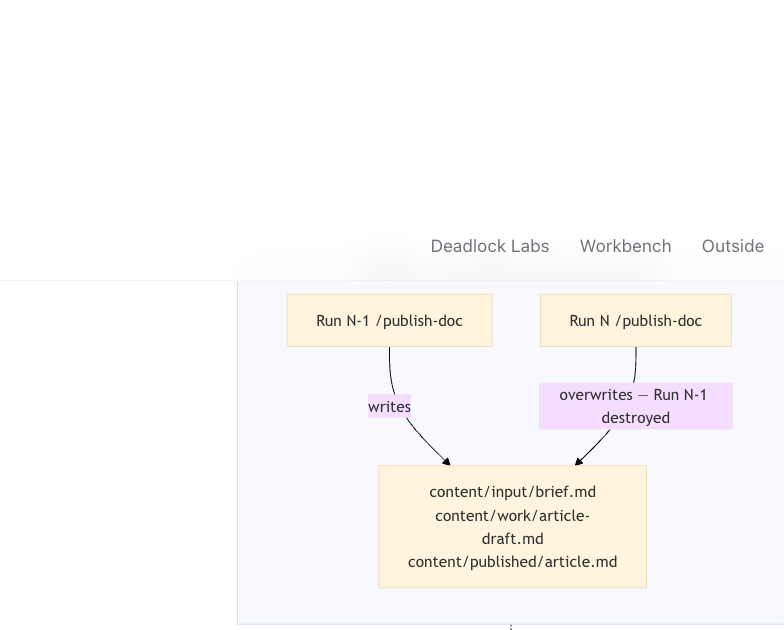
The same failure mode existed in content/. Every /publish-doc invocation wrote to the same three files: brief.md, article-draft.md, article.md. Run two overwrote run one completely. There was no history, no baseline, and no way to compare two runs side by side.
Both problems share one root cause: the pipeline had no concept of a run identity.
The Fix: Run-Scoped Naming Convention
The fix is a naming convention enforced at step 1 of every pipeline invocation.
At the start of each run, the pipeline derives a stable run ID from two components: a timestamp from date +%Y%m%d_%H%M%S and a slug generated from the brief's H1 title (lowercase, non-alphanumeric replaced with hyphens, consecutive hyphens collapsed):
TIMESTAMP=20260627_105134
SLUG=brief-wiring-the-citadel-observatory-and-run-naming-convention
RUN_ID=20260627_105134_brief-wiring-the-citadel-observatory-and-run-naming-convention
From that RUN_ID, three scoped paths are derived:
BRIEF = content/input/brf_<run-id>.md
WORK  = content/work/wrk_<run-id>/
PUB   = content/published/pub_<run-id>/
Every step in the pipeline reads and writes through $WORK and $PUB. Nothing writes to a flat filename anymore. The original brief is copied to its stamped path but never deleted.
The result is visible in the repository right now. content/published/ holds two intact directories:
pub_20260627_092341_lab-note-building-the-citadel/
pub_20260627_105134_brief-wiring-the-citadel-observatory-and-run-naming-convention/
The same pattern was applied to the House of Personal Writing. create-personal-piece.md runs the same step 1. The standalone review-personal-piece.md and publish-personal-piece.md commands accept the wrk_* path as $ARGUMENTS, falling back to the most recently modified directory if none is provided.
Migrating the existing flat files reconstructed timestamps from their last-modified times. No content was lost.
Observatory Automation: What the Run Record Captures
Step 10 of publish-doc.md fires unconditionally — whether the pipeline succeeded or failed at step 7. It writes a JSON record to:
observatory/quality-reports/<run-id>.json
The record is defined by observatory/schemas/run-record.schema.json. Fields written per run:
house— which pipeline produced the recorddate,run_id,brief_slug,brief_path— run identitypipeline_status—"published"or"failed"output— paths toarticle.md,publish-manifest.json,release-notes.md; allnullif the pipeline failed before step 9models— model ID per role (writer, illustrator, reviewer, editor, publisher)review.status,review.confidence,review.cycles,review.summary,review.required_changes_count— pulled from$WORK/review-result.jsoncost_usd,latency_seconds— bothnull; those fields require API instrumentation that does not exist yet
The models and output objects use additionalProperties in the schema, so both houses write to the same schema without house-specific variants. A failed run is still recorded. An incomplete record with pipeline_status: "failed" and null outputs is valid data — it tells you the run happened, which review cycle it reached, and how confident the reviewer was before stopping.
The schema_version field is present on every record so future dashboard tooling can handle schema evolution without guessing.
What Was Created and What Was Modified
Files created:
observatory/schemas/run-record.schema.json— JSON Schema v2020-12 for observatory records~/.claude/commands/brief.md— global/briefskill; saves a Why/How/What session summary tocontent/input/brf_<timestamp>_<slug>.md
Files modified:
observatory/README.md— now documents automated population, the field list, and dashboard readinesshouses/house-of-technical-publication/CLAUDE.md— "Standard File Paths" replaced with "File Naming Convention" documentingbrf_/wrk_/pub_prefixeshouses/house-of-technical-publication/.claude/commands/publish-doc.md— step 1 (run ID) and step 10 (observatory write) added; all internal path references now use$WORKand$PUBhouses/house-of-personal-writing/CLAUDE.md— same naming convention section addedhouses/house-of-personal-writing/.claude/commands/create-personal-piece.md— step 1 + step 11 observatory patternhouses/house-of-personal-writing/.claude/commands/publish-personal-piece.md— derivesPUBfrom$ARGUMENTSor most recentwrk_*houses/house-of-personal-writing/.claude/commands/review-personal-piece.md— same fallback
Files renamed (migration, no data lost):
content/input/brief.md→content/input/brf_20260627_092341_lab-note-building-the-citadel.mdcontent/work/*.md,review-result.json→content/work/wrk_20260627_092341_lab-note-building-the-citadel/content/published/*.md,publish-manifest.json→content/published/pub_20260627_092341_lab-note-building-the-citadel/- Personal writing:
content/input/brief.md→content/input/brf_20260627_075710_brief.md
Takeaway
The Observatory was passive because the pipeline had no run identity. Once you add a stable RUN_ID at step 1, everything downstream — file isolation, artifact paths, observatory records — becomes a naming problem, not an architecture problem. The /brief skill closes the remaining gap: it captures the session before it disappears into chat history and drops a stamped brief file directly onto the /publish-doc input path.